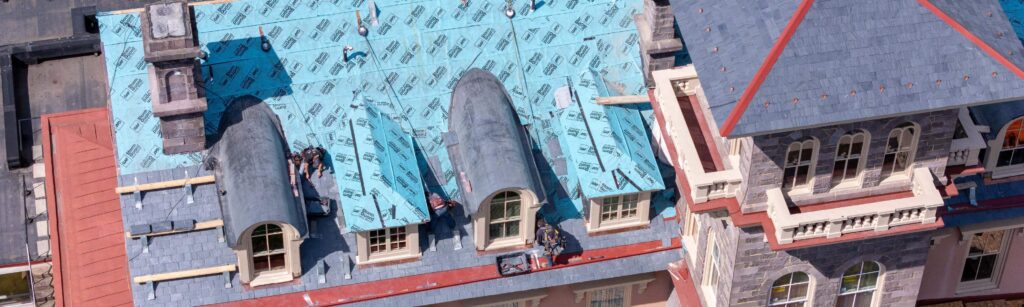
Why Central Pennsylvania Property Owners Choose Slate Restoration to Honor the Buildings They Steward
At Weaver Commercial Roofing, we have spent more than 53 years working on historic and institutional properties across Lancaster, Berks, Lebanon, York, Hershey, the Main Line, and Philadelphia. We install and maintain nearly every major (trusted) commercial material and roofing system available on the market. And we have learned something important over five decades: the right roof for a building is the one that fits its structure, its history, and its future.
For most historic sloped buildings, that answer is still slate.
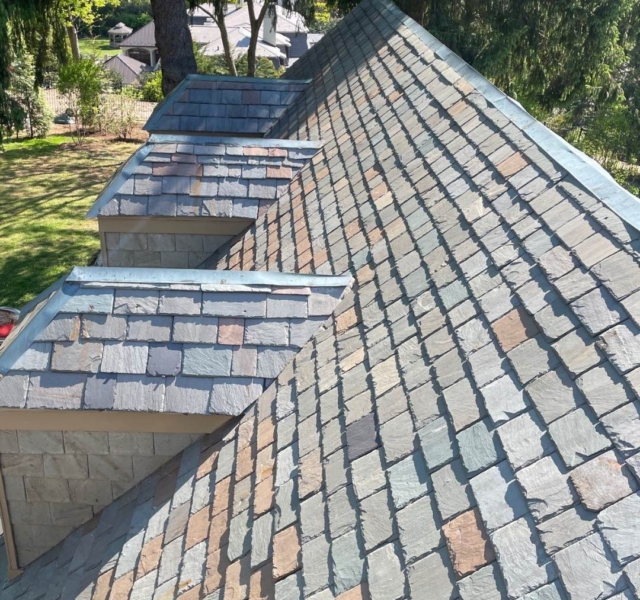
Slate Was Built to Last.
Here is something that surprises a lot of property owners: the majority of aging slate roofs are not failing because the slate itself has given out. The slate is often fine.
What fails first is usually the flashing, the fasteners, the underlayment, or a handful of cracked or slipped tiles. These are repairable problems. They do not require a complete system replacement, and they certainly do not require abandoning a material that was designed to outlast generations.
Slate that was installed in the late 1800s and early 1900s was quarried from some of the densest, most durable stone available. When properly installed, it was built to outlast the people who put it there. In many cases across Central Pennsylvania, it has done exactly that.
So before writing off a slate roof, it is worth finding out what is actually wrong with it.
Perform a Slate Roof Assessment
A proper roof evaluation requires someone who understands how slate systems are constructed and how they age. At Weaver, this is a detailed report that comes with no charge. We review:
- The condition of individual tiles, including checking for delamination, breakage, and slippage
- Flashing integrity at chimneys, valleys, dormers, and penetrations
- Fastener condition and whether nails have corroded or pulled through
- Underlayment and deck condition beneath the slate
- Ridge and hip cap details
- Drainage patterns and areas of recurring moisture exposure
The goal is to give you an honest understanding of what the roof actually needs. Sometimes that means a full restoration. Sometimes it means targeted repairs that extend the roof another 20 to 30 years. Either way, you deserve accurate information before making a decision that affects the character of your building for decades to come.
Choosing the Right System for Your Historic Building
Every roofing decision involves trade-offs, and we believe property owners should understand them clearly. When a historic sloped building with original slate comes up for evaluation, the core question is not which modern system is easiest to install. It is which system best serves this specific building over the long term.
Slate on a sloped, architecturally significant structure offers some things that are genuinely difficult to replicate:
Longevity matched to the building itself.
A quality slate restoration can add 50 to 75 years of service life to a roof that is already proven. That kind of lifespan aligns with the way historic buildings are meant to be stewarded, not constantly re-roofed.
Appearance that honors the original design.
Historic buildings were designed with slate as part of their visual identity. The texture, color variation, and character of natural stone contribute to how a building reads from the street and how it fits within its neighborhood or district. Restoring that material keeps the building looking the way its architects intended.
Compatibility with historic preservation requirements.
Many older commercial and institutional properties in Central Pennsylvania fall under local historic preservation guidelines or sit within historic districts. Keeping the original roofing material, or replacing it in kind with new slate, is often the most straightforward path through those review processes.
Fire resistance.
Slate is completely non-combustible, which can be a meaningful factor for certain property types and insurance considerations.
None of this is to say that other roofing systems are the wrong choice across the board. We work with property owners every day on flat and low-slope applications where modern membrane systems are exactly the right answer. The key is matching the system to the building, not defaulting to whatever is fastest or most familiar.
TLC & Maintenance
If your slate roof is in serviceable condition, consistent maintenance is the best investment you can make. Deferred maintenance is almost always more expensive than proactive care, and it is the most common reason good slate roofs end up in trouble.
A sound slate maintenance program includes:
- Annual or biannual inspections by someone trained in slate systems
- Prompt replacement of broken or slipped tiles before water infiltrates the system
- Flashing inspection and resealing at all penetrations and transitions
- Gutter and drainage maintenance to prevent ice damming and water backup
- Ridge cap monitoring, as this is often the first area to show wear
- Documentation of roof condition over time to track changes and plan ahead
Many of the emergency roof calls we receive could have been avoided with a modest annual investment in inspection and minor repairs. A slate roof that is checked regularly and cared for promptly will almost always outperform one that is ignored until a problem becomes unavoidable.
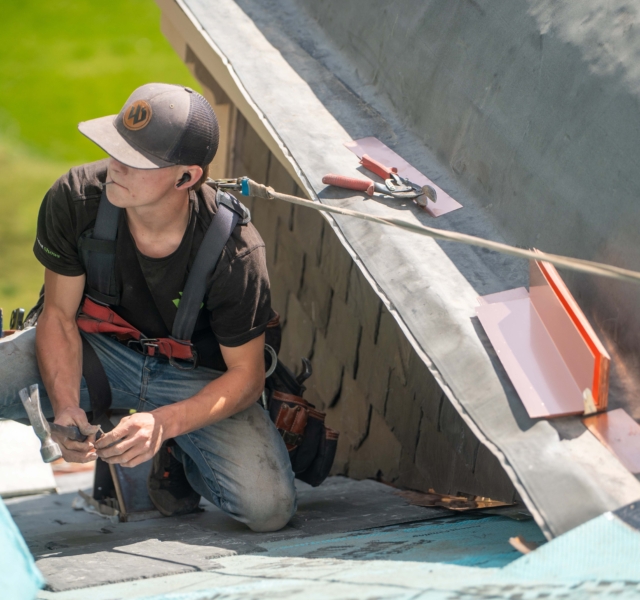
Honoring What Was Built
There is a reason the architects and builders of the 1800s and early 1900s chose slate. They were building things meant to last. The churches, courthouses, school buildings, and commercial properties that define the character of Lancaster, York, and communities across Central Pennsylvania were not built to be disposable. They were built to endure.
Restoring a historic slate roof is an act of stewardship. It says that what was built well deserves to keep standing well. It preserves the visual continuity of a building that has been part of a community for generations, and it does so while delivering performance that few systems can match on a sloped, architecturally significant structure.
We have worked on buildings where the original slate was installed before anyone alive today was born. When we complete a restoration on a roof like that, there is something genuinely satisfying about knowing it will likely outlast us too.

Choosing the Right Contractor Matters More Than the Material
Here’s the truth most articles will not tell you. A roofing system is only as good as the people installing it. Shortcuts may not show up right away, but they always show up eventually and more costly than you’d expect. That’s exactly why we go the extra mile before, during, and after your roofing project is complete. Delivering not only lasting results, but intentional craftsmanship that means little to no disruption to your business and operations in the process.
With Weaver you can expect:
- Clear communication
- Reliable timelines
- Quality and professional workmanship
Serving Central Pennsylvania Businesses for Over 50 Years
Built on Experience. Backed by Care. We do not believe in one-size-fits-all recommendations. Every building is unique, and every client has different priorities. That is why we take the time to understand your property, your business, and your long-term goals.
It is all part of delivering on our promises, listening to our clients needs, and delivering quality work.
Industries we’ve served:
- Churches & Cathedrals
- Business offices
- Schools & Institutional Campuses
- Senior living communities
- Restaurants
- Property management companies
- Hospitality groups
- Warehouses and distribution centers
- Cold storage facilities
If you are evaluating a commercial roof replacement or need guidance around Slate, we are here to help you make a decision you won’t second-guess years down the road.
***
Weaver Commercial Roofing is a GAF Master Elite contractor and Elevate Partner In Quality member, meaning we successfully install and maintain a minimum of 1M square ft of roof while meeting Elevates strict QIR (quality incident rating) standards.